

This was our first TUgis conference, and we came away impressed by how well it was run and how many opportunities there were to learn from other GIS professionals across government, consulting, academia, and the private sector. Some of the most useful conversations happened outside the formal sessions, in the exhibit hall, over lunch, and between presentations, where people were comparing how they are dealing with many of the same challenges around data, systems, automation, asset management, and AI.
AI-Ready vs. Decision-Ready Data
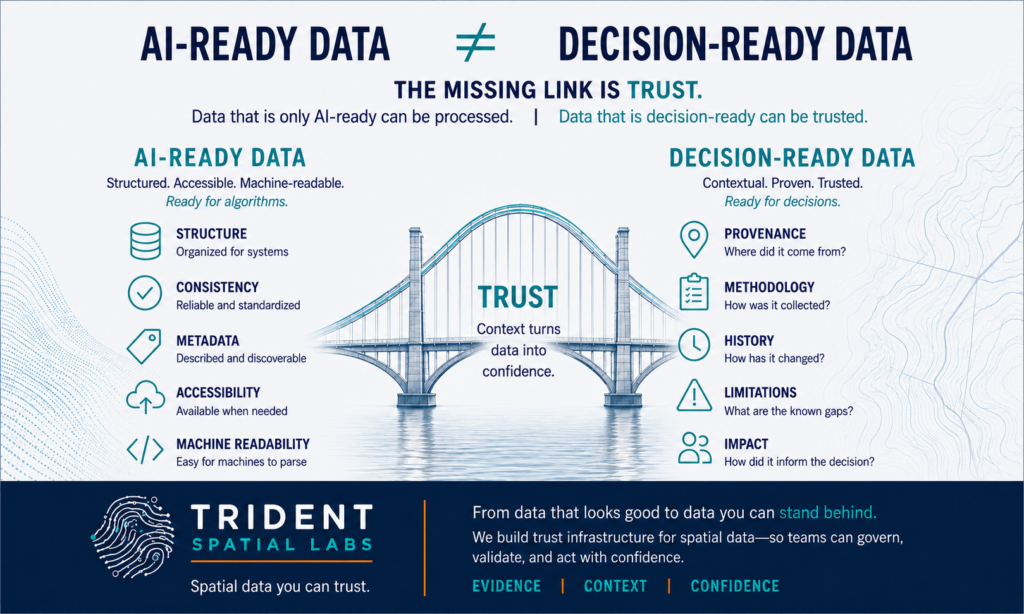
One idea in particular has stayed with us. During a TUgis presentation on modernizing sewer asset data collection in Howard County, a clear distinction was made between AI-ready data and decision-ready data. They are not the same thing.
We have heard a great deal of discussion about AI-ready data, but much less about decision-ready data. This is an important gap in the conversation, especially as autonomous AI agents are increasingly being used across sectors and participating more directly in operational and decision workflows.
What Makes Data Decision-Ready?
We can make data AI-ready by improving structure, consistency, metadata, accessibility, and machine readability. But that does not necessarily make the data trustworthy enough to support a decision. Decision-ready data also requires context: where it came from, how it was collected, what assumptions shaped it, how it has changed, what its limitations are, which version was used, and what other information influenced the eventual decision.
A Broader Shift for GIS
That distinction connected with a much broader theme we heard throughout TUgis. GIS professionals are no longer dealing only with maps and spatial data. They are increasingly working across data quality, automation, governance, legacy systems, asset management, AI, and the difficult question of how to get trustworthy information into the hands of people who need to act on it.
Connecting the Conversation to Trident
Those are increasingly connected problems, and they are closely related to the work we are doing at Trident Spatial Labs. With the TRUST Audit and Attashe, we are interested not only in whether organizations have good data and good technology, but whether they can understand where information came from, whether it can be trusted, how it changed, and how it contributed to a decision.
What We Took Away
TUgis gave us a useful opportunity to test those ideas against the problems GIS professionals are dealing with every day. We came away with new contacts, new ideas, and several directions worth exploring further.
For our first TUgis, it was time well spent.
What Does Decision-Ready Mean to You?
We’d be interested in hearing how others are thinking about this distinction. We talk a lot about AI-ready data, but what does it take for data to become decision-ready—and trusted enough to act on?